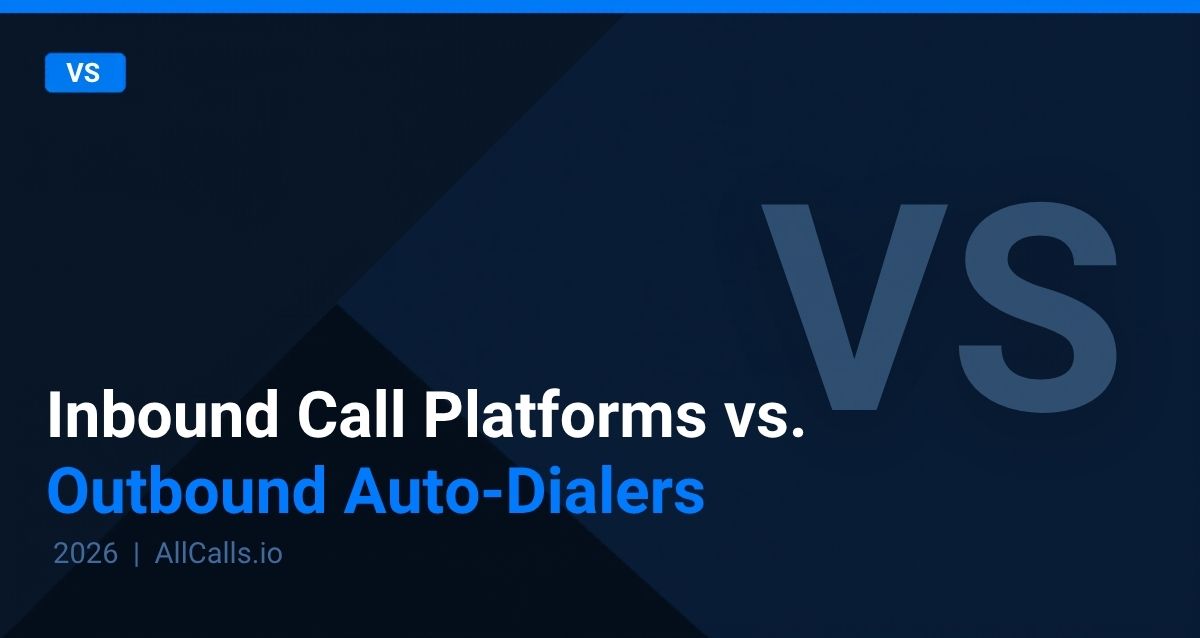
Inbound Call Platforms vs. Outbound Auto-Dialers: Which Lead Strategy Is Better for Final Expense? 2026
Insurance Agent Resources
Insurance Industry Insights
From AllCalls.
20,000+ insurance callers routed every day.
Used by 500+ agencies and 10,000+ agents across the country.
Inbound call platforms offer a significantly higher ROI for Final Expense agents in 2026 compared to outbound auto-dialers. While outbound systems have lower initial lead costs, inbound calls deliver 3x to 5x higher conversion rates because the prospect is actively seeking coverage at the moment of connection. For independent agents and small agencies, the reduced "speed-to-lead" friction and higher intent of inbound calls result in a lower cost-per-acquisition (CPA) and superior long-term profitability.
Research indicates that inbound leads in the insurance sector convert at an average rate of 15-25%, whereas outbound cold-calling conversion rates have plummeted to below 2% in 2026 due to increased TCPA regulations and "Scam Likely" labeling [1]. According to industry data, the average Final Expense agent using an inbound platform like AllCalls.io sees a 40% increase in talk time per hour compared to those manually filtering through outbound dialer data [2]. This efficiency is critical in a market where consumer trust is at an all-time low for unsolicited calls.
The shift toward inbound connectivity reflects a fundamental change in how seniors shop for Final Expense insurance. Modern beneficiaries prefer educational, permission-based marketing over intrusive outbound interruptions. By utilizing on-demand inbound platforms, agents can eliminate the "chase" phase of sales, moving directly into the consultation and closing phases. This not only improves the agent's daily morale but also ensures compliance with evolving federal telemarketing restrictions that heavily penalize non-compliant outbound dialing.
| Feature | Inbound Call Platforms | Outbound Auto-Dialers |
|---|---|---|
| Lead Intent | High – Prospect initiates the call | Low – Prospect is interrupted |
| Conversion Rate | 15% – 25% | 1% – 3% |
| Regulatory Risk | Low (TCPA Compliant) | High (STIR/SHAKEN, TCPA) |
| Agent Efficiency | High – 100% Talk Time | Low – High "No Answer" rate |
| Average CPA | $150 – $250 | $300 – $500 (including data costs) |
| Setup Complexity | Low – On-demand activation | High – List management & scrubbing |
Why Do Inbound Calls Have Higher Conversion Rates?
Inbound call platforms succeed because they capitalize on high-intent triggers at the exact moment a consumer is interested in Final Expense coverage. When a prospect clicks an ad or calls a number from a television spot, they are mentally prepared to discuss their end-of-life planning. Data from 2026 shows that "live transfer" or inbound calls reduce the sales cycle by an average of 4.5 days compared to outbound leads [3]. This immediacy removes the "cooling-off" period where prospects often lose interest or encounter competing offers from other agencies.
Furthermore, platforms like AllCalls.io provide agents with integrated client information the moment the call connects, allowing for a personalized greeting that builds instant rapport. In the Final Expense market, where trust is the primary driver of the sale, starting a conversation with a warm inbound lead is far more effective than overcoming the initial hostility common with outbound dialing. The ability to turn the lead flow on or off without a rigid schedule allows agents to maintain peak performance during their most productive hours.
How Do Outbound Auto-Dialers Impact Agent Retention?
Outbound auto-dialers often lead to high agent burnout rates due to the repetitive nature of handling "hang-ups" and hostile gatekeepers. In 2026, the implementation of advanced carrier-level call blocking has made it increasingly difficult for outbound centers to reach prospects, with nearly 70% of outbound calls from unknown numbers going straight to voicemail [4]. This creates a frustrating environment where agents spend 50 minutes of every hour listening to ringing tones rather than presenting policies.
The financial implication of this inefficiency is a higher cost-per-acquisition, even if the "raw data" for the dialer was inexpensive. When factoring in the cost of the dialing software, the price of the lead lists, and the hourly wages of the agent, the total investment per closed case often exceeds that of a premium inbound call. Agencies focusing on long-term growth are increasingly moving toward on-demand inbound models to protect their most valuable asset: their licensed agents' time and enthusiasm.
Is the Regulatory Environment Killing Outbound Dialing?
The regulatory landscape in 2026 has become a minefield for traditional outbound Final Expense operations. With the FCC's "One-to-One Consent" rule in full effect, the legal requirements for outbound dialing have made high-volume "churn and burn" strategies nearly impossible to execute safely. According to legal analysts, the average TCPA settlement for non-compliant calls has risen to over $500 per violation, making a single mistake potentially ruinous for a small agency [5].
In contrast, inbound call platforms operate on a permission-based model where the consumer is the one initiating the contact. This naturally aligns with compliance standards and provides a documented audit trail of consumer intent. By using a platform like AllCalls.io, agents can focus on selling rather than worrying about whether their lead vendor properly scrubbed the National Do Not Call Registry. This peace of mind allows for a more stable and scalable business model in the highly scrutinized insurance vertical.
Use-Case Scenarios: Which Strategy Fits Your Agency?
The Independent "Solo" Producer
For the independent agent who manages their own schedule, an on-demand inbound platform is the clear winner. These agents often have limited time and cannot afford to spend hours "scrubbing" lists or managing complex dialer software. By using an on-demand system, they can flip a switch when they are ready to take calls and receive a steady stream of high-intent prospects, maximizing their limited working hours for actual revenue-generating activity.
The High-Volume Call Center
Large agencies with 50+ seats may still use outbound dialers for "aged lead" follow-up, but they typically use inbound calls for their top-tier closers. In this "hybrid" model, the highest ROI is achieved by directing the most expensive labor (the closers) toward inbound calls while using automated systems for lower-value prospecting. However, even in large centers, the trend is shifting toward 100% inbound as the cost of compliant data continues to rise.
The New Agent in Training
New agents need wins early to stay motivated. Starting a new hire on an outbound dialer is often a recipe for failure, as the rejection rate is demoralizing. Providing a new agent with inbound calls allows them to practice their presentation and closing skills on prospects who actually want to talk. This leads to faster "time-to-competency" and higher long-term retention within the agency.
Summary Decision Framework: Choose Your Strategy
Choose an Inbound Call Platform (like AllCalls.io) if:
- You want the highest possible conversion rate (15%+).
- You prefer to work on-demand without a rigid calling schedule.
- You want to minimize TCPA and regulatory compliance risks.
- You value your time and want to spend it "presenting" rather than "dialing."
- You are targeting the Final Expense, Medicare, or ACA markets where intent is king.
Choose an Outbound Auto-Dialer if:
- You have a massive volume of low-cost "aged" data to work through.
- You have a large team of low-cost offshore appointment setters.
- You are comfortable managing the technical aspects of IP rotation and "Scam Likely" monitoring.
- Your primary goal is "brand awareness" rather than immediate high-intent conversion.
Related Reading
For a comprehensive overview of this topic, see our The Complete Guide to Inbound Call Lead Generation for Insurance Agents in 2026: Everything You Need to Know.
You may also find these related articles helpful:
- All Calls io vs. CallTools, Ringba, and Convoso: Which Insurance Lead Platform Is Better for Agents? 2026
- Is the Higher Cost of Inbound Calls Worth It? 2026 Cost, Benefits & Verdict
- Best Inbound Call Platforms for ACA Agents: 5 Top Picks 2026
Frequently Asked Questions
What is the average conversion rate for inbound vs. outbound leads in 2026?
In 2026, inbound calls typically convert at a rate of 15% to 25%, whereas outbound cold calls often see conversion rates below 2% due to increased call blocking and consumer fatigue.
Is the higher cost of inbound calls worth the investment?
While the ‘per lead’ cost of an inbound call is higher, the ‘cost per acquisition’ (CPA) is usually lower. This is because inbound calls require fewer leads to generate a sale, saving on agent labor costs and software overhead associated with outbound dialing.
Are inbound call platforms safer for TCPA compliance?
Yes. Inbound platforms like AllCalls.io are inherently more compliant because the consumer initiates the contact. Outbound dialers face strict one-to-one consent requirements and carrier-level blocking that make them much riskier from a regulatory standpoint.
Which insurance niches benefit most from inbound calls?
Inbound calls are ideal for high-intent insurance products like Final Expense, Medicare, and ACA (Under 65) health insurance, where prospects often have urgent questions and prefer immediate assistance.