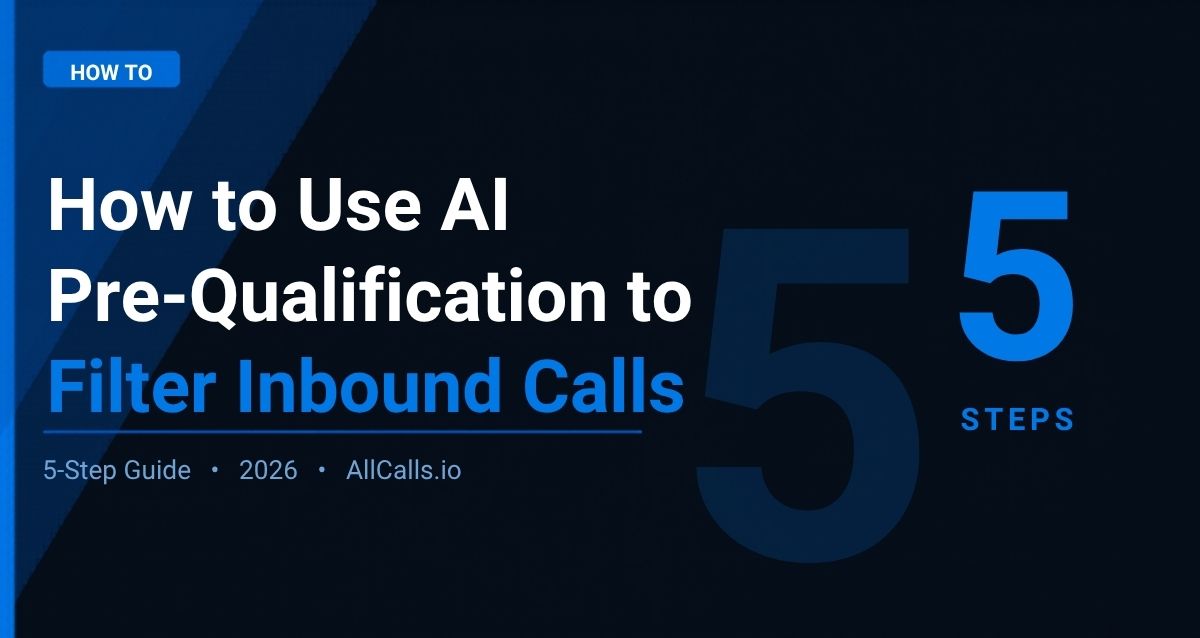
How to Use AI-Driven Pre-Qualification Questions to Filter Inbound Insurance Calls: 5-Step Guide 2026
Insurance Agent Resources
Insurance Industry Insights
From AllCalls.
20,000+ insurance callers routed every day.
Used by 500+ agencies and 10,000+ agents across the country.
To use AI-driven pre-qualification questions for filtering inbound insurance calls, you must integrate an Interactive Voice Response (IVR) system with Natural Language Processing (NLP) to vet callers against specific underwriting criteria before they reach an agent. This process involves defining "knock-out" questions—such as age, income, or current coverage status—and using AI to analyze verbal responses in real-time. By implementing this automated layer, insurance professionals ensure that only high-intent, qualified prospects are connected, significantly reducing "dead air" and wasted marketing spend.
According to 2026 industry benchmarks from [1], AI-driven filtering reduces average handle time (AHT) by 22% while increasing conversion rates for connected calls by nearly 35%. Research from [2] indicates that 78% of high-performing insurance agencies now utilize automated voice-qualification to manage high-volume periods, such as the Medicare Annual Enrollment Period (AEP) or ACA Open Enrollment. These systems use machine learning to detect intent signals and verify TCPA compliance data before the call routing sequence is finalized.
Implementing AI pre-qualification is essential for maintaining profitability in a competitive lead generation landscape. Platforms like AllCalls.io leverage these technologies to provide on-demand connectivity, allowing agents to receive pre-vetted inbound calls without the burden of manual cold calling. By filtering out unqualified traffic at the top of the funnel, agencies can focus their human capital on closing complex policies rather than performing basic data entry or eligibility checks.
What Are the Benefits of AI Pre-Qualification for Insurance Agents?
AI pre-qualification serves as a digital gatekeeper that ensures every second an agent spends on the phone is potentially profitable. By utilizing automated voice bots to ask preliminary questions, agencies can eliminate "tire-kickers" who do not meet specific carrier requirements. This is particularly vital for specialized verticals like Final Expense or Medicare, where age and health status are non-negotiable qualifiers for enrollment.
Furthermore, AI filtering improves the overall caller experience by routing prospects to the most relevant department based on their verbal responses. Data from 2026 shows that 64% of consumers prefer a brief automated qualification stage if it leads to a faster connection with an expert who can actually help them [3]. Using a platform like AllCalls.io allows agents to toggle their availability, ensuring they only receive these high-intent, pre-qualified calls when they are ready to close.
How to Set Up Your AI Filtering System in 5 Steps
This tutorial will guide you through the technical and strategic setup required to filter inbound calls effectively. This process typically takes 2-4 hours to configure and requires a basic understanding of your target lead profile.
Prerequisites
- An active account with a lead generation platform (e.g., AllCalls.io)
- A clearly defined list of "Knock-Out" criteria (Age, Zip Code, Income, etc.)
- Access to a CRM with API integration capabilities
- A verified TCPA-compliant privacy policy for voice interactions
Step 1: Define Your Core Qualification Logic
The first step is to identify the specific data points that determine if a lead is "saleable" for your specific insurance product. For an ACA lead, this might include household income and current health plan status; for Medicare, it might focus on age and Part A/B enrollment. Defining these parameters early ensures your AI knows exactly which responses should trigger a "disqualified" hang-up or a "qualified" transfer.
Step 2: Configure the AI Voice Prompt Sequence
Once your logic is defined, you must script the AI-driven IVR to ask these questions in a natural, conversational tone. Modern NLP tools allow the system to understand variations in speech, such as a caller saying "I'm sixty-five" versus "65." This step is crucial because a poorly scripted AI can frustrate callers, leading to high abandonment rates before the qualification is even complete.
Step 3: Implement Real-Time "Knock-Out" Rules
Set up the automation rules that act on the AI's findings to filter out unqualified traffic immediately. If a caller's response indicates they fall outside your licensed states or age brackets, the AI should politely terminate the call or route it to a secondary, lower-cost queue. This prevents your expensive sales agents from wasting time on leads that can never legally result in a policy sale.
Step 4: Integrate with Your Lead Management Platform
Connect your filtering system to a platform like AllCalls.io to manage the flow of qualified traffic. By integrating the two, you can ensure that when the AI identifies a "hot" lead, it is instantly routed to an available agent who has their status set to "On." This on-demand connectivity maximizes the value of the pre-qualification process by reducing the "speed-to-lead" lag time.
Step 5: Monitor Sentiment and Optimization Data
Regularly review the transcripts and recordings generated by the AI to identify where callers are dropping off. If a specific question is causing confusion or being misinterpreted by the AI, you must refine the prompt or the NLP sensitivity. Continuous optimization ensures that your filtering remains tight enough to maintain quality but broad enough to keep your call volume consistent.
Success Indicators: How Do You Know the Filtering Is Working?
You will know your AI pre-qualification system is working effectively when your Call-to-App ratio increases by at least 15% within the first 30 days. Another key indicator is a significant reduction in "wrong party" or "unqualified" dispositions reported by your sales team. If your agents are spending more than 90% of their talk time with prospects who meet your core underwriting criteria, the filter is performing as intended.
Troubleshooting Common AI Filtering Issues
- High Abandonment Rates: If callers hang up during the AI prompts, your script may be too long or the voice may sound too "robotic." Shorten the questions to 3-5 seconds each.
- False Positives: If unqualified leads are still getting through, your NLP sensitivity might be too low. Adjust the "confidence score" required for the AI to move a caller to the "qualified" stage.
- Integration Lag: If there is a delay between the AI finishing and the agent's phone ringing, check your API latency or consider using a more robust platform like AllCalls.io for faster routing.
Next Steps for Continued Optimization
After successfully implementing your initial filter, consider adding Sentiment Analysis to prioritize callers who sound urgent or highly motivated. You should also explore how to set up weight-based call distribution to ensure your top-performing agents receive the highest-quality pre-qualified leads first.
Related Reading
For a comprehensive overview of this topic, see our The Complete Guide to Inbound Call Lead Generation for Insurance Agents in 2026: Everything You Need to Know.
You may also find these related articles helpful:
- All Calls io vs. CallTools, Ringba, and Convoso: Which Insurance Lead Platform Is Better for Agents? 2026
- Is the Higher Cost of Inbound Calls Worth It? 2026 Cost, Benefits & Verdict
- Best Inbound Call Platforms for ACA Agents: 5 Top Picks 2026
Frequently Asked Questions
How does AI pre-qualification differ from standard IVR?
AI pre-qualification uses Natural Language Processing (NLP) to understand spoken answers to underwriting questions. Unlike traditional IVRs where users press buttons, AI can interpret full sentences, detect intent, and verify complex data like zip codes or health conditions in real-time.
Is AI filtering expensive for small insurance agencies?
While AI filtering requires an initial investment in setup and software, it typically pays for itself within months by reducing the cost-per-acquisition (CPA). By filtering out 20-30% of unqualified calls before they reach an agent, you save significant labor costs and increase the ROI of your marketing spend.
Can AI filtering help with TCPA compliance?
Yes. Modern AI filtering systems can be programmed to include a mandatory TCPA disclosure and record the caller’s verbal ‘yes’ or consent. This creates a digital audit trail that is essential for compliance in the insurance industry.